
 Dr. Kyle Eastwood is a recent graduate of the Royal College Emergency Medicine Residency program at Dalhousie University. Originally from Ontario, Kyle studied Mechanical Engineering and Management at McMaster University and subsequently completed the MD-PhD program at the University of Toronto. During his clinician-scientist training, Kyle’s research interest focused on the engineering design of surgical instruments for minimally invasive Neurosurgical and ENT applications. Kyle’s clinical interests include the care of critically ill trauma patients and translational research focused on simulation, medical technology and Artificial Intelligence. Outside of medicine, Kyle enjoys backcountry camping and spending time with his partner and their young daughter, Lara.
During residency, Kyle’s research portfolio included the following:
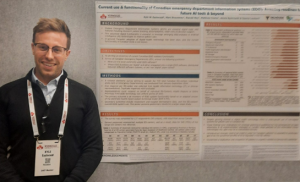 Project 1: Investigating the applications of Artificial Intelligence in Emergency Medicine. Supervised by Dr. Loubani, Kyle obtained a NSH Research Fund Grant to support this work. The project output included three peer reviewed studies1-3 with three conference presentations4-6. In two of the arms of the project, Kyle supervised medical students in completing their RIM projects.
Project 2: Disseminating the education innovation of a Disaster simulation for Dalhousie Medical Students. Dr. Armstrong and Dr. Harris led a multidisciplinary team to develop a new interprofessional mass casualty simulation. Kyle worked with this group to disseminate the findings of this work as a peer-reviewed journal paper and presented the results at an international emergency medicine conference7-8.
Project 3: In his PGY-5 year, Kyle completed an area of concentrated interest at Queens University through their Resuscitation and Reanimation fellowship program. During this time, Kyle and his co-fellows developed an Artificial-Intelligence (AI) supported self-directed small-group learning strategy. This adult-learning approach was disseminated through a peer-reviewed journal paper.9
Project 4: This work is currently underway and involves a quality improvement initiative focused on integrating End-tidal Oxygen monitoring into intubations completed at the QEII Emergency Department. This project involves a large group of our colleagues, including Dr. Parks, Dr. Sowers, Dr. Kovacs, Dr. Gardner, Laura Berry, Ryan Fitzpatrick, Ashley Spears and many others from our interdisciplinary ED health team.
References:
- Eastwood KW, May R, Andreou P, Abidi S, Abidi SS, Loubani OM. Needs and expectations for artificial intelligence in emergency medicine according to Canadian physicians. BMC Health Services Research. 2023 Jul 25;23(1):798.
- [Under Review] Donovan M, Eastwood KW, May R, Andreou P, Garagan C, Loubani OM. Artificial intelligence in emergency nursing: Insights from Canadian nurses on needs and potential.
- [Under Review] Eastwood KW, Brousseau M, Matheson K, Bystrzycki A, May R, Clarke M, Loubani OM. An Inventory of Emergency Department Information Systems (EDIS) in Canada: Benchmarking System Functionality and Technology Readiness.
- Eastwood KW, May R, Andreou P, Abidi S, Abidi SS, Loubani OM. A survey of needs & expectations for artificial intelligence according to Canadian emergency physicians. Oral Presentation. Canadian Association of Emergency Physicians 2023 National Conference, Toronto, 2023.
- Donovan M, Eastwood KW, May R, Andreou P, Garagan C, Loubani OM. Artificial intelligence in emergency nursing: insights from Canadian nurses on needs and potential. Poster Presentation. International Conference on Emergency Medicine (ICEM) 2025, Montreal, 2025.
- Eastwood KW, Brousseau M, Matheson K, Bystrzycki A, May R, Clarke M, Loubani OM. Current use & functionality of Canadian emergency department information systems (EDIS): Assessing readiness for future AI tools & beyond. Poster Presentation. International Conference on Emergency Medicine (ICEM) 2025, Montreal, 2025.
- Eastwood KW, Harris A, Armstrong JB. A disaster medicine course for Canadian medical students: first implementation of a large-scale mass-casualty simulation. Canadian Journal of Emergency Medicine. 2023 Dec;25(12):949-52.